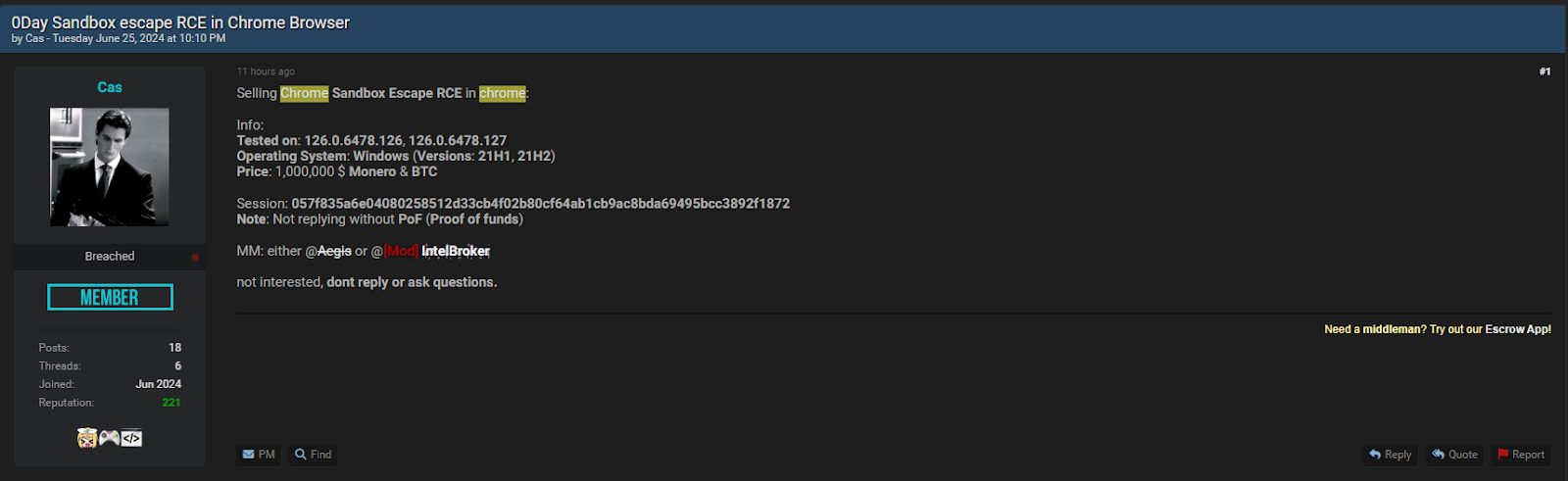



Another alarming discovery in the cyber-security landscape shakes the internet. A threat actor put on sale (on BreachForum) a dangerous 0-day vulnerability affecting the Google Chrome browser. This flaw, named “Sandbox RCE”, allows for arbitrary code execution with high privileges, exposing vulnerable systems to an elavated risk.
The advertisement specifies that the vulnerability has been tested on two distincts Chrome versions (126.0.6478.128 and 126.0.6478.127) and the targets Windows OS systems (version 21H1 e 21H2). A RCE is a critical vulnerability that permits a bad actor to execute malicious code on a target device remotely, without the victim’s knowledge. The threat is amplified because it bypass the browser’s sandbox, an enviroment designed to isolate browser’s processes from accessing the OS.

In the sale announcement the seller states “Selling Chome Sandbox Escape RCE in chrome”, including the price fixed at 1.000.000 USD. The only payment methods allowed are Monero (XMR) or Bitcoin (BTC), cryptocurrency use grant anonymous payments. The elevated cost suggests thatan highly reliable and powerful exploit.
A well-known threat actor called IntelBroker would act as middleman making easy the payment and exploit delivery. Moreover a middleman should provide trust and transparency incentivizing the purchase. This specific couple of buyre and middle-man are the same that provided another advertisment for a Linux Kernel 0-day a few days ago.
0-day vulnerabilities define the biggest threat in the digital space, this flaw are unknown to the product supplier and the patch cannot be developed until a proof of the vulnerability gets uncovered. In the context of the Chrome Browser’s Sandbox the potential bypass of the safeguars and the possibility of execute code at OS level expose systems to an high risk. Every user and company should implement available security measures to protect their system. Sharing and collaboration of information inside the infosec community are essential to face dangerous threat like 0-days in an efficient way.
Chrome is the most used web browser in the world, with a market share >60%. This means the potential victims range is really wide. Regular updates, security softwareand common sense are required to avoid to be caught by this exploit. Regardless all the mitigation measures active in systems we must remember the zero risk doesn’t exist.

QUATTRO LEZIONI PER COMPRENDERE IL DARKWEB ED ENTRARE DA PROTAGONISTI NELLA CYBER THREAT INTELLIGENCE.
Per info e iscrizioni: 📱 Whatsapp 379 163 8765 ✉️ [email protected]
Dopo il successo delle scorse edizioni, Red Hot Cyber è lieta di annunciare una nuova live-class del corso "Dark Web & Cyber Threat Intelligence". A differenza dei corsi e-learning pre-registrati, queste lezioni online in tempo reale, condotte dal professor Pietro Melillo, offrono un’esperienza formativa interattiva e coinvolgente, ideale per approfondire i contenuti e affrontare casi pratici.
Le Live Class sono progettate per garantire un apprendimento mirato e personalizzato, con un massimo di 14 partecipanti per sessione. Questo consente di adattare il percorso formativo alle esigenze specifiche, ma anche di mantenere alta la qualità: i posti sono limitati e nelle scorse edizioni sono andati in sold-out due settimane prima dell’inizio. Prenota subito per assicurarti il tuo posto!
Risorse online:
Al termine del corso, potrai accedere all’esclusivo Laboratorio di Intelligence DarkLab, un ambiente operativo dove mettere in pratica le competenze acquisite. Sarà l’occasione per sperimentare attività di investigazione nel Dark Web, analisi delle minacce e redazione di report di intelligence e ricerche approfondite.
Per info e iscrizioni: 📱 Whatsapp 379 163 8765 ✉️ [email protected]